The 2026 State of the API Report: agents are in production, and most APIs aren’t ready

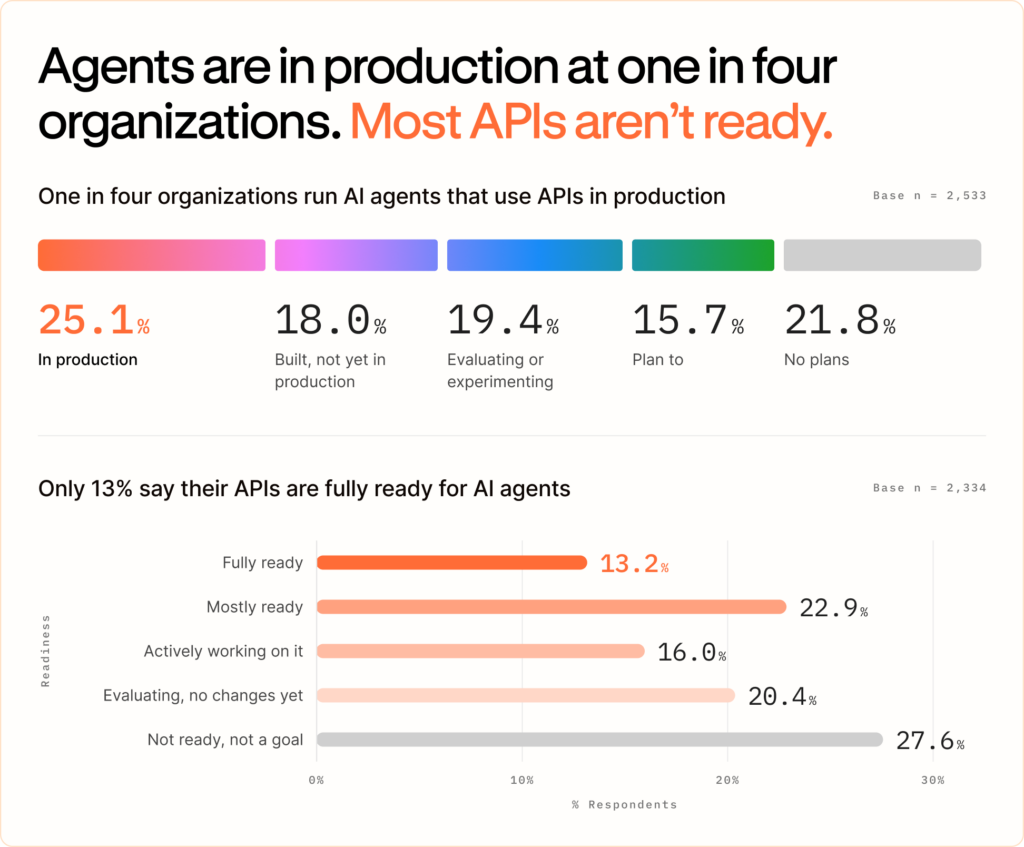
One in four organizations now run AI agents that use APIs in production. Only 13.2% say their APIs are fully ready for them.
That gap headlines the 2026 State of the API Report, our eighth annual look at how the world builds with APIs. We surveyed 8,953 developers, architects and executives, and the data says something we could not have written a few years ago: the consumer of APIs is increasingly software that cannot read docs or ask a teammate a question. Read the full 2026 State of the API Report.
Agents are in production. APIs are not ready.
Picture a team that shipped an agent last quarter. The agent books travel, issues refunds and sends the weekly report. In order to accomplish all of that, it has to call a dozen internal APIs.
Those APIs were built years ago for developers. A person could read the docs, ask a teammate when a call failed, and work around the odd error. An agent cannot do any of that. It needs clear descriptions, predictable errors, tight permissions, and a way to find the right endpoint in the first place.
So here is the question I keep asking teams: were those APIs built for it?
For most teams, no. 38.7% still design APIs primarily for human developers reading docs, and only 5.6% design primarily for agent. Just 36.1% say their APIs are fully or mostly agent-ready, and only 13.2% say fully. That leaves a lot of agents leaning on APIs designed for people.
I do not think this is a failure, but instead, something that happens when a new kind of consumer arrives faster than the tooling. This is certainly a gap that organizations need to close.
API-first teams are pulling ahead.
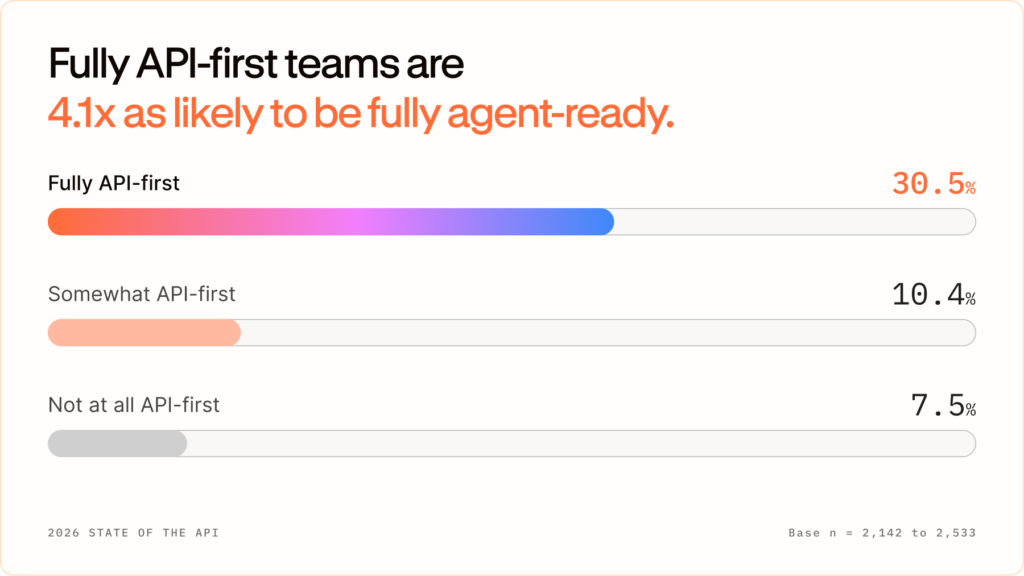
The most interesting comparison in the data is between teams that are fully API-first and and everyone else who is not API-first at all. The difference is remarkable.
- 2.6x as likely to run agents in production: 43.2% vs 16.7%
- 4.1x as likely to be fully agent-ready: 30.5% vs 7.5%
- More revenue from APIs: 55.0% earn more than a quarter of revenue from them, vs 14.7%
But, there is one caveat since I care about getting this right; The data shows association, not cause. Teams that already invest in APIs may simply be the ones that invest in everything. Still, the pattern is hard to ignore. Teams that treat their APIs as products are the ones more prepared for agents.
MCP is real. Discovery is not solved.
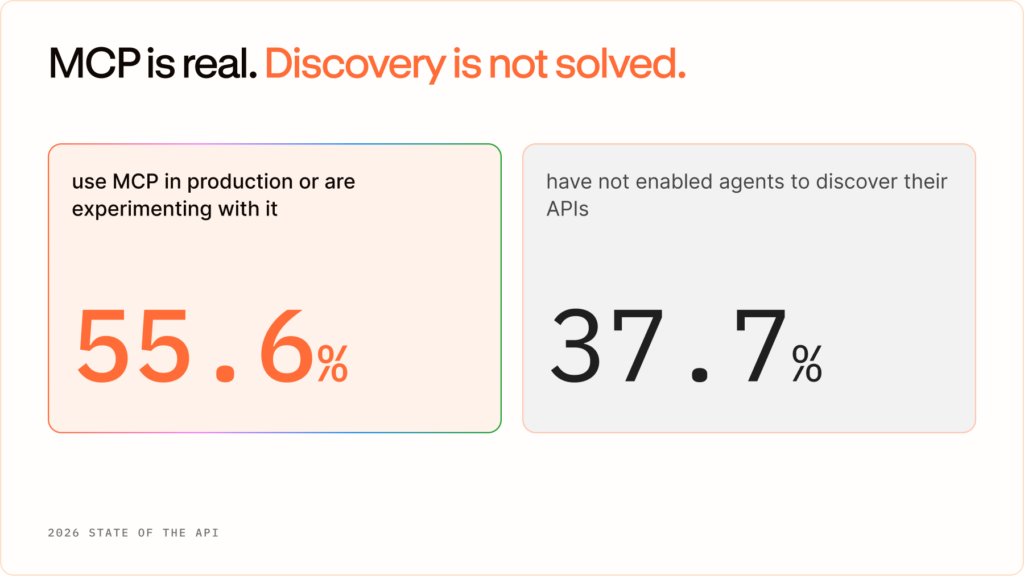
MCP has rapidly gone from a spec to a habit. 55.6% are in production or already experimenting with it, and 23.8% are already in production.
We see the same thing in our own data. On Postman, requests from AI agents to the Postman API through our MCP server grew 3.3x between May and October, to more than 2 million a month, and the number of people sending them grew 2.2x, to nearly 33,000. Agents are also running Postman themselves. In the week of November 2, more than 18,000 Postman CLI installations were invoked by AI coding agents, about half of them running collections.
However, agents can only use what it can actually find. 37.7% have not enabled any discovery for agents, even as 12.2% say recommendations from AI agents or coding tools are already a top factor in choosing which APIs to use. If an agent cannot find your API, it will use someone else’s.
This is why we built the Context Graph API. One map of your API ecosystem that both people and agents can read. We have MCP support for it coming shortly.
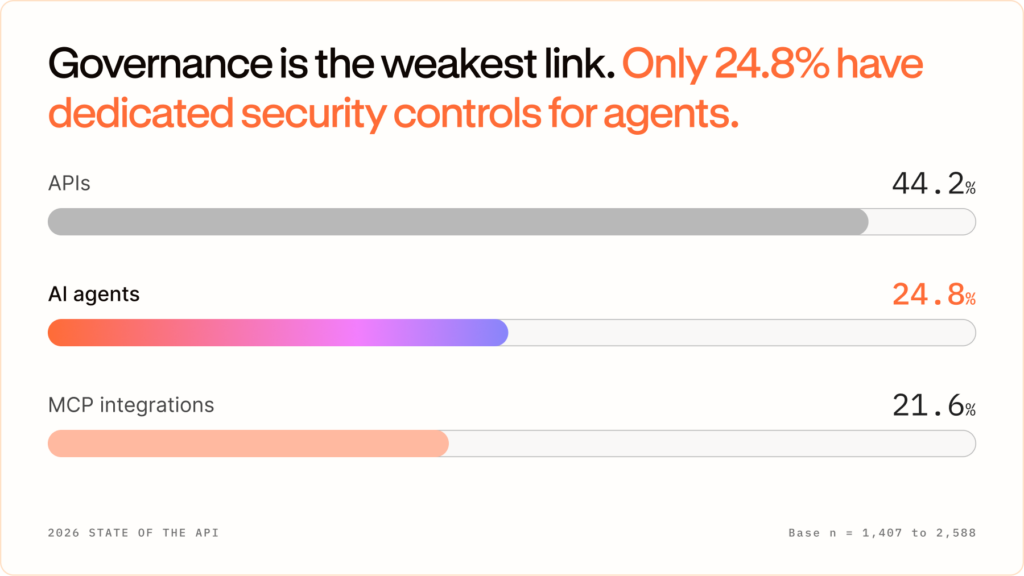
Governance is the weakest link
Agents are non-human callers and most teams have not caught up. 39.7% have not addressed how credentials and identity work for agents. 44.2% have dedicated security controls for their APIs, but only 24.8% do for agents and 21.6% for MCP. 22.1% still store credentials in environment variables or .env files, and only 13.4% use short-lived credentials.
Our own platform data shows why this matters. More than half of what agents do through the Postman MCP server is write: 51% of tool calls create or change collections and requests, versus 46% that only read. Agents aren’t just looking at your APIs. They’re changing things.
This is the part that worries me most, because the fix is not exotic. It is identity, short-lived credentials and a control point in front of agent traffic. Only 19.1% route agent or MCP traffic through a gateway today.
We have been working on this. Both recently GA, Passport gives teams a way to manage identity and Fabric Gateway puts policy in the path of agent traffic. For teams that cannot use the cloud, Private Cloud is available now and an air-gapped client is coming in early 2027.
What you can do next
If you are to take three things from this report, let them be these:
- Build the map and make it discoverable. 34.0% have no formal process for managing agents, and 37.7% have not enabled agent discovery. Start with an inventory of your APIs and agents, then map it with the Context Graph API so people and agents can both find what exists.
- Generate docs and SDKs from the spec. 49.7% name incomplete or outdated documentation as their top collaboration blocker, and 44.4% say developers write and update docs themselves. Fern turns your API definition into docs and SDKs that stay current for people and agents.
- Put identity and a gateway in front of agents before you scale them. Passport and Fabric Gateway are built for this.
The full report has the data by role, region and industry. I would love to hear what you see in your own stack.
These gaps are real, and most teams are working through them right now. Read the 2026 State of the API Report, then see what we have built to help you get ahead of agents:
- Passport: secretless API access for people
- Fabric Gateway: the control plane for agent traffic
- Fern: docs and SDKs generated from your API definition
- Register on demand: How CISOs Deliver Secure API Access with Passport






What do you think about this topic? Tell us in a comment below.