
MCP goes stateless — and Postman’s ready

The next Model Context Protocol specification (2026-07-28) lands on July 28. Postman’s MCP Inspector already supports it, including the new stateless transport, so you can test and debug your servers before, during, and after you migrate.
What actually changed
There’s a lot in this release, but the headline is simple: MCP is now stateless.
Before, every connection meant a session: a handshake, a session ID, and sticky routing to keep a client pinned to one server instance. That was tricky to run in production. Now an MCP server behaves like any ordinary HTTP service. You can put a load balancer in front of it and scale it horizontally, the way you already scale everything else.
Alongside that come MCP Apps, tighter authorization, and a handful of deprecations. For the full spec breakdown, read the official release post. We won’t repeat it here.
What it means for server developers
If you maintain an MCP server, moving to the new spec is a breaking change when you upgrade. The good news: the upgrade path isn’t bad. The official SDKs are already updated, and most of the work is infrastructure. You enable stateless mode and drop the session machinery you no longer need.
The recommended approach is a transition period where your server speaks both transports at once: the legacy one for existing clients, and the new one for clients that have upgraded. That way nothing breaks while the ecosystem catches up.
How Postman helps you migrate
Postman’s MCP Inspector is built for exactly this moment:
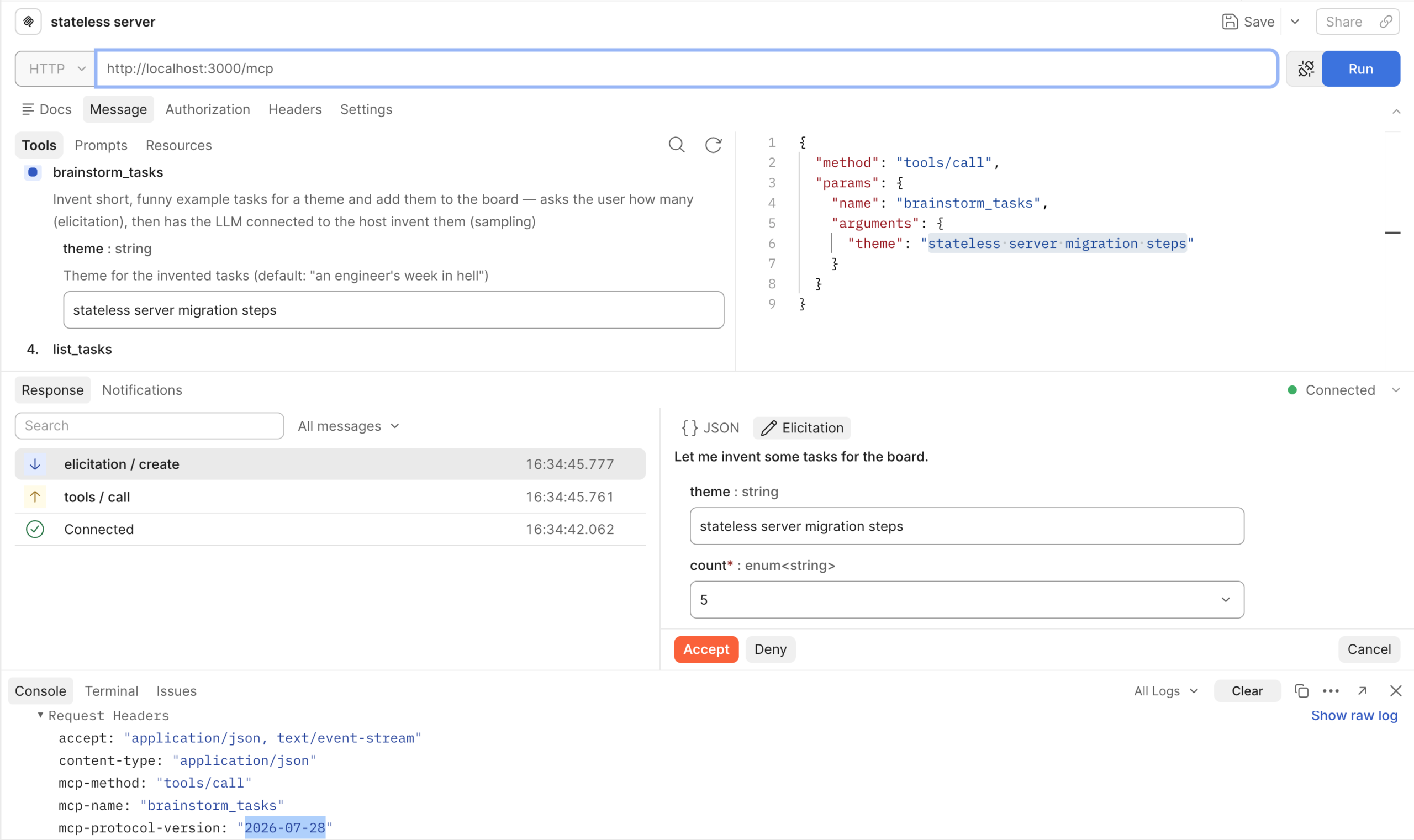
- Automatic transport detection. Connect to a server and Postman detects which transport it’s using, new or legacy, and shows you the negotiated protocol version in the console.
- Test both sides. Serving new and legacy in parallel? Point Postman at either. Select the legacy option to confirm existing clients still work, then verify your new stateless endpoint behaves correctly.
- Debug stateless behavior. Because there are no sessions, multi-turn flows like elicitation now carry their context in the request itself. Postman lets you fire an elicitation request, fill the form, approve it, and watch the whole round trip work without a session.
Existing servers don’t break, and nothing changes for anyone who isn’t upgrading yet. When you’re ready to move, Postman gives you a way to prove the new protocol and stateless mode work before you ship.
Get started
The MCP Inspector in Postman is ready today. Upgrade a server, point Postman at it, and see the new transport in action ahead of the July 28 release.
Resources
- Model Context Protocol specification
- MCP official site and release notes
- MCP SDKs on GitHub
- Postman MCP Inspector documentation
- Postman AI Agent Builder






What do you think about this topic? Tell us in a comment below.