
Introducing the AI Engineer

Postman’s AI-native API platform is getting a major upgrade today. We’re excited to announce the launch of the AI Engineer, the next leap for Postman AI capabilities.
Developers have been the fastest adopters of AI. That’s no surprise: code is abundant training data, and code generation is verifiable in ways most knowledge work isn’t. But building software has never been just writing code.
From conversations with customers and our own experience at Postman, taking software from prototype to production is a fundamentally different activity than generating code. Recent weeks have made this visible at scale. The Wall Street Journal ran a piece last week on what it called “vibe slop”; the bug-ridden, hard-to-maintain output of teams prompting their way past the hard parts of software. The engineers building some of the most popular AI coding tools are themselves warning that infrastructure is crumbling and software is getting more bug ridden. You can’t vibe your way to production.
Agents will nonetheless be a core part of the SDLC going forward. The work of integrating them, and of doing real engineering alongside them, is what Simon Willison calls agentic engineering: figuring out what to build, navigating tradeoffs, and keeping systems coherent as they grow. Agentic engineering now extends well beyond coding agents to every kind of agent involved in the SDLC.
What is the problem?
As agents become part of engineering teams, two distinct challenges emerge in non-trivial applications:
- How do agents understand existing software systems well enough to be productive companions?
- As software production accelerates, how do agents stay on course without creating a spaghetti mess?
Software systems evolve from prototypes into landscapes of thousands of APIs, services, databases, and event queues. As these systems come into existence, they don’t just interact in the ways they were designed. They interact with each other in ways no one fully anticipated.
With AI and agentic engineering, all of this happens at a much faster pace. As production increases, so does context debt. Like technical debt, context debt compounds: every new service, every new contract, every agent-generated change adds to the body of prior work that any future change has to understand.
Vibe slop is the visible symptom. Context debt is the underlying disease. Fixing the first without fixing the second just moves the failure mode upstream. You ship cleaner code into a system no one understands anymore.
I believe context debt will soon become intractable for humans. The rate at which agents will produce software is going to outstrip the rate at which any human team can absorb what’s been built. The companies that figure out how to manage context debt will outship the ones that don’t.
What is the solution?
Our answer to context debt is the AI Engineer — the continued evolution of Postman’s agentic capabilities.
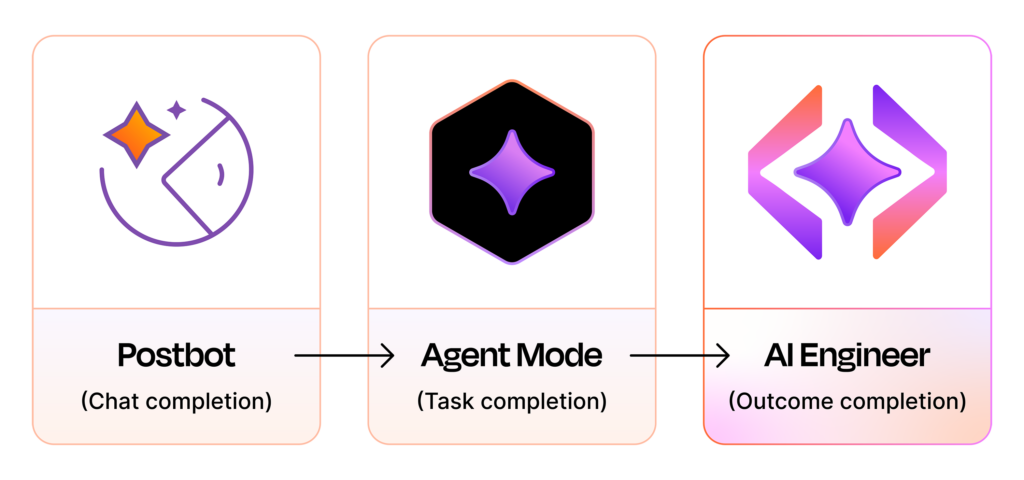
With the AI Engineer, you can spin up agents to take on a range of agentic engineering work: from exploring an undocumented API to reviewing a system design to running QA on every PR.
The AI Engineer is powered by the Context Graph, an always-on, continuously updated map of the APIs and services across your Postman organization. It runs in a secure sandboxed cloud environment where it can pull in code repositories, run bash commands, spin up UI tests, and use every Postman capability natively.
You can run it on command through Postman, in Slack, via the API, and soon through the CLI. Wherever your team already works, the AI Engineer will be available.
What it can do?
The AI Engineer can do many workflows but here are some specific ones where we think it can excel:
Directed API Exploration.
Point the AI Engineer at an API or an application and give it a goal. It will explore endpoints, infer behavior, and produce documentation, a working collection, and a map of how the API actually behaves — not just how the spec says it should.
System Design Reviews.
The AI Engineer can review architecture across services, surface dependency risks and inconsistencies, and propose changes — grounded in what already exists in your Context Graph, not in generic best practices.
API Design.
Given a goal, it can draft new API specifications or propose improvements that fit the conventions, naming, and contracts of your existing API surface — so new designs land coherently instead of as one-off shapes.
Root Cause Analysis.
When something breaks, the AI Engineer can trace the problem across services. It uses the Context Graph to navigate dependencies and Postman tools to actively test APIs, then returns a hypothesis with reproduction steps, the work a senior engineer does in the first hour of an incident, available on demand.
API Testing and QA on Every PR.
Plug the AI Engineer into your PR review process and it will automatically check changes for contract regressions, breaking changes, security issues, and design inconsistencies — catching API problems before they merge.
How it works
The AI Engineer rests on four components, each addressing a different part of the context debt problem.
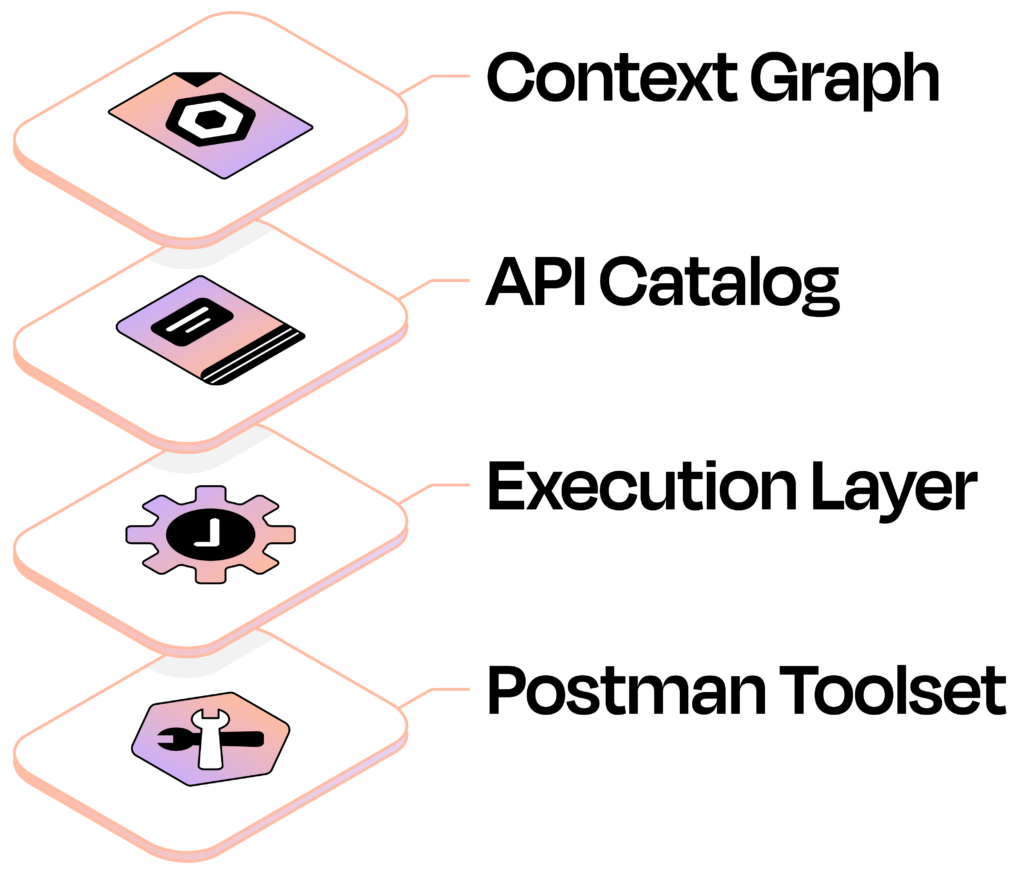
The Context Graph is the memory layer. It continuously maps the APIs, services, and dependencies across your organization, so an agent starting a task doesn’t start from zero. This is the answer to how do agents understand existing systems.
The API Catalog is the management plane. It defines which APIs exist, who owns them, and what’s authorized, giving the agent the same guardrails a human engineer operates within.
The Execution Layer is how the agent acts. It runs inside a sandboxed cloud environment where it can pull repositories, run bash commands, execute UI tests, and use every Postman capability — without ever touching production directly.
The Postman Toolset is the set of capabilities that the agent has access to. All of Postman’s existing capabilities have been packaged up through tools specifically designed for high performance by the AI engineer.
Together, this is how the AI Engineer stays on course as it works: grounded in real system context, executing in isolation, and bounded by the same governance your team already uses. It’s integrated with your existing code review process, so its work shows up where engineering work already shows up.
Why Postman?
Building an AI engineer for APIs isn’t a model problem, it’s a context problem. The hard part isn’t getting an agent to reason; it’s giving it something real to reason about.
Postman has spent more than a decade as the system of record for APIs across millions of developers and hundreds of thousands of organizations. The collections, environments, specs, and workspaces that engineering teams have built up over years are exactly the substrate the Context Graph runs on. We’re not starting from scratch. We’re activating context that’s already there.
A generic coding agent can write you a function. It can’t tell you which of your seventeen payment APIs is the canonical one, who owns it, what depends on it, or whether your new design conflicts with three existing contracts. That’s the work the AI Engineer is built to do.
Is it safe?
The agents run in sandboxes and do not touch your infrastructure or your Postman instance unless you ask them to.
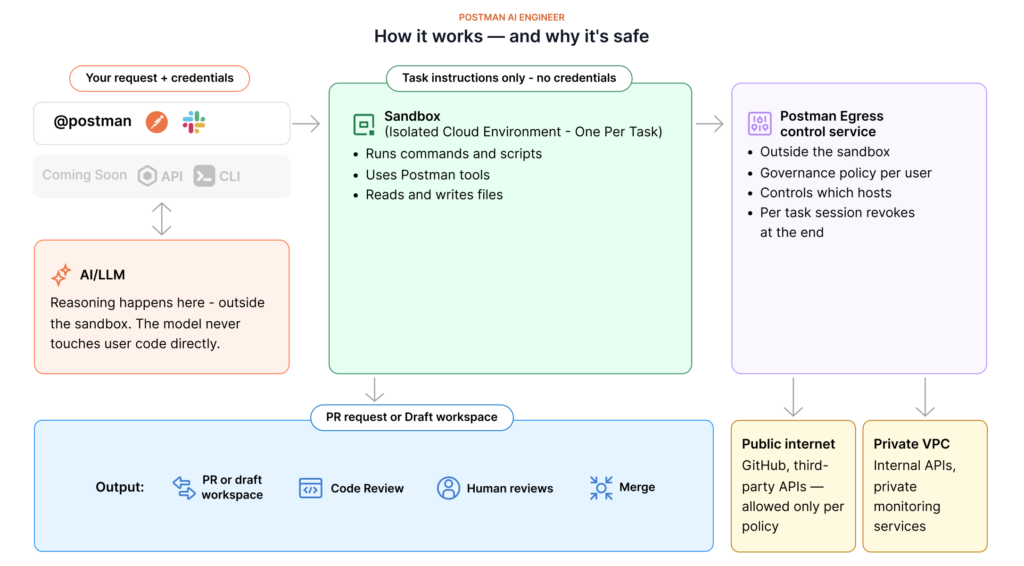
They operate within the boundaries of your workspace and the credentials you grant them, scoped to the APIs you authorize. Credentials never travel through an agent’s reasoning layer. We have also created a separate execution layer that lives within your VPC and it controls what the agent asks it to call.
Write operations require explicit human approval. Output goes through your existing PR review process. Our risk model is similar to a junior engineer whose work goes through code review, with humans in the loop on anything that matters.
We’ve been running these agents internally on our own engineering workflows. If it isn’t good enough for us to use every day, it isn’t good enough to put in front of customers. Our customer advisory board members across regulated industries have also been giving us feedback as we shape what we ship next.
How to get access
This post is the first in a series. Over the coming weeks our product team will share deeper looks at the Context Graph, how we built the execution sandbox, what we’ve learned running these agents inside Postman, and how customers are starting to use them.
The AI Engineer is available today. Get started. We are rolling out in early access and will open up to more segments over time as we ramp up capacity.
Context debt is going to be the defining challenge of the next decade of software engineering. Vibe slop is what it looks like when you ignore it. We’re building the tools to help your team get ahead of both.


What do you think about this topic? Tell us in a comment below.